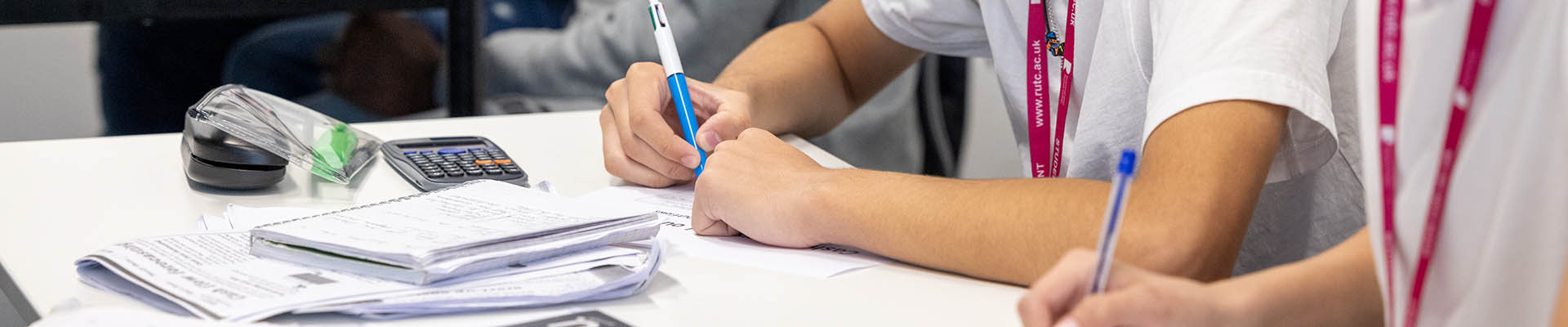
Examinations and assessments don't have to be daunting if you prepare well. Follow our hints and tips below. And remember: Stay positive, keep healthy and just do your best!
How to prep for exams?
 Planning well and being organised helps you stay on top of your studies.
A good plan will also help you stay focussed and reduces the feeling of being overwhelmed.
-
Make a plan
Planning and organising your study is key. You know you want to do well and will study hard, but it can be difficult to know how or where to begin.
Planning is the first step:
- Make a revision timetable with the topics you need to study
- Take subjects you like and dislike into consideration – don't avoid the ones you don’t like. Instead, mix them up with the ones you do like to make less of a chore
- Know the key dates, times and locations of your exams and assessments
- Attend your classes
- Be aware of exam regulations
- Discuss any concerns with your teachers
- Make sure you set aside enough time for leisure and other commitments
- And most importantly, stick to the plan!
-
Create a revision programme
- Create a timetable
- Use a topic list to cover all areas
- Use a variety of activities eg. mindmaps and revision cards
- Work with friends, asking questions and explaining to each other
- Work through past papers and look at mark schemes
- Understand key vocabulary linked to your subject
- Short, sharp session work best
- Use resources from college / school
- Attend revision sessions.
-
Set goals
Goals give you an endpoint to focus on. This could be a deadline for finishing a chapter, or attaining a certain score on a practise test, or simply studying for a set amount of time.
Whatever it is, set SMART (Specific, Measurable, Attainable, Realistic and Timed) goals and don’t forget to reward yourself when you achieve them. Goals are a stepping stone to completing your studies in a structured way.
-
Choose the right location
- Find a quiet, comfortable place to study
- Make sure you have plenty of light and enough space for your books
- Ensure the area is free from distractions like your phone, noise, pets etc
- Keep your study and writing materials at hand before you begin your studies.
-
Stay fit and healthy
Eating a healthy diet is essential to help you focus and concentrate on your studies. Stay hydrated and drink plenty of fluids. Make time for exercise and get outdoors between your studies.
It’s also important to get enough sleep at night. If you like studying late into the night or early in the morning, make sure you catch up on lost sleep.
-
Take breaks
Last but not the least. Take a break!
Taking breaks is very important. Long periods of study without breaks, diminishes your focus and concentration. Breaks will help you pay more attention and helps bring your mind back to focus on your studies.
Breaks can also be a way to reward yourself for attaining study goals. Such as spending break time on social media, talking to a friend, watching an episode of your favourite programme etc.
What are the best revision hacks?
 When it comes to revising for exams, you can improve your results through good planning and better studying habits.
Follow our top revision hacks to help ace your exams:
-
Top revision hacks
Take notes
- Make your own revision notes: you'll learn as you write
- Get virtual: log onto your virtual learning environment to access notes and information to help you
Revise and test- Search websites: GCSE Bitesize and YouTube are ideal for revision guides to find practical help and advice
- Test yourself: focus on subjects you find difficult
- Plan - don't cram: list the topics you need to cover then create a revision timetable
- Practise: look at past exam papers and see how the questions could be asked and time yourself
- Highlight key areas: using colours and symbols - visuals help you remember facts
- Find yourself a quiet and tidy space to revise: it will help you concentrate, especially if there are no distractions.
Take regular breaks: your concentration lapses after a couple of hours. -
Useful links and apps to help with exams
Revision Apps on Apple Appstore and Google Play: Edplace | Gojimo | Quizlet | BBC Bitesize
How to keep calm and study on?
 Exams can feel overwhelming, but there are steps you can take to control your nerves and feel more confident.
Take a look at some of our tips below:
-
What is stress / anxiety?
Feeling stressed means feeling anxious about something that you’re having difficulty controlling or confronting. It can also affect motivation, making it hard to study for exams.
What causes exam stress?
- Pressure from others
- Perfectionism
- Fear of failure or unmet learning needs
- Worrying about next steps
- Lack of preparation
- Challenges with focus and motivation.
A small amount of stress is necessary. It’s part of our natural warning system, making us alert to danger and ready to run from threatening situations. In an exam situation, a small amount of adrenaline pumping through your body keeps you alert.How to recognise exam stress and / or anxiety
Thoughts:
- I will fail
- Others will be disappointed in me
Behaviours:- Avoidance and procrastination
- Argumentative
- Isolating yourself from others
Emotions:- Crying and tearful
- Being angry
- Body responses:
- Sweating
- Headaches
- Freezing / inactivity / fatigue
-
Manage your studying
Don’t go mad and lock yourself in with your books 24 hours a day.
Two/three hours is the maximum you can study before you stop absorbing what you read, so break up periods of work with periods of relaxation.
Reward yourself for your hard work.
- Exercise
- Practice relaxation exercises
- Socialise
- Do your hobbies
- Maintain a regular sleep schedule
- Take breaks
- Plan your study time
- Stay hydrated
- Eat well.
-
Have a sense of perspective
Do your best, work hard and prepare well.
Obviously, you want to do well, but if you don’t do as well as you hoped, there are always alternative opportunities.
Your college / school can help you with these IF that happens.
-
Be nice to yourself
Self-affirmation works wonders!
Tell yourself that you can do it, and psyche yourself up with positivity before the day. You could try some of these affirmations:
Confidence and preparation
- I have prepared well, and I am ready
- I can succeed
- I am smart, capable, and confident.
Calmness and focus- I am calm and focused under pressure
- I approach each question with clarity
- My mind is clear and calm.
During the exam- I can recall the information I need easily and accurately
- I am performing to the best of my ability
- I have plenty of time to complete this exam.
After studying- I deserve to take breaks and rest
- My efforts today contribute to my success tomorrow
- I have done enough and I am proud of my effort.
-
Look after yourself
Take regular study breaks and when you’re not studying don’t dwell on exam worries.
Hobbies and sports can make you feel more relaxed and boost your confidence.
Feed your brain with healthy foods and make sure you get enough sleep; a light snack or a glass of milk and a warm bath will help you relax before bed.
Pro tip: Bananas are a great pre-bed snack, because they contain nutrients that help your muscles relax and the brain to calm, helping to reduce stress and promoting a more restful sleep.
When your exams are over – plan a party, a trip, or something that will help you to relax and celebrate!
- Useful links for exam stress
How to prep for exam day
 You've done all the prep work, but what about exam day itself?
Follow these simple tips to ease your nerves on exam day:
-
The night before the exam
The night before can be hard.
Don’t start revising completely new areas, it’ll just freak you out. Instead, stick to key points and summaries, rather than big chunks of text.
If it feels like nothing’s going in, don’t worry. Whatever revision you do now will pay off later. Finally, get a decent night’s sleep and you’ll perform better.
-
On exam day
Be sure you know exactly when, where and how long each exam is.
Allow plenty of time for travel and arrive on time – you may not be allowed to sit the exam if you are later than the specified time.
Ensure you have the right equipment for the exam e.g. pens, ruler, calculator, where appropriate.
-
During the exam
Read:
- All the instructions carefully so you know how many questions to answer, what they’re worth and which ones are compulsory
- All the questions and avoid leaping on the first ‘easy’ one you spot.
Plan:- Which questions you want to answer and in what order
- How much time you’ve got for each one – put your watch in front of you and try and stick to your timings
- A list of points to give you a structure for essay questions.
Write:- Answers to the questions that have actually been set, not the ones you’d hoped to see. Beware of questions you recognise from past papers, they may have been subtly changed
- As concisely as possible – keep to the pointAs neatly, and as quickly, as you can. Try not to spend too long on any single question however much you get into it
- A concise list of what you would have put in your answer if you find yourself running out of time, that way you should still score some points
- Use any spare time you have at the end of the exam for checking through your answers.
Avoid!Panicking – sometimes your brain takes time to find facts. Calmly re-read the paper and you’ll soon get into gear.
Help and support
 However you’re feeling about your exams, it’s important to realise that you’re not alone. There are lots of people out there who can help.
Here are just a few:
-
Family
Your parents or guardians have probably been through testing times and will have had to sit exams of their own. They’re likely to be happy to talk through your concerns and may be able to offer you some help and advice.
Older siblings who have recently been through exams are also a good source of information and guidance.
-
Friends
Speaking with friends may be enough to remove some of your fears. After all, most people doing exams will be feeling the same and sometimes, just knowing you’re all in the same boat can make you feel better.
-
Teachers, tutors and Student Support Officers
You can talk to the people responsible for your course about any concerns you have about your exams and assessments.
They support students every year and are there to support you this time around.
You can also speak to Student Support Officers who are always more than happy to help.
-
Support groups
Many groups meet to support each other about matters such as stress and exam pressure. Find out about them from teachers or lecturers, student liaison officers or your local medical centre.
-
Doctors
If you find that you are really struggling to cope, then you can always speak to your doctor.
However, there are also charities like Mind, that may be a good first option. They can offer advice and support.
-
Exam regulations
These are all a bit formal, but it’s important you know the regulations to avoid penalities or disqualifictaions:
- Ensure you have your Student ID badge
- Arrive early before your exam. An attendance register will be placed outside the exam room for you to find out which number desk to sit at. The invigilator will call you in when they are ready
- If you are running late, please inform your lecturer/ attendance coordinator to tell Exams staff immediately.
Mobile phones and tech- Mobile phones, iPods, MP3 players, Smart watches not to be used and switched off, placed in your bag at the front of the room or handed into an exams officer/invigilator
- Any type of watch/mobile/headphones/air pods must be switched off and handed in.
What NOT to do- No hats of any kind to be worn during the exam
- No notes to be taken into the exam
- No communicating with other students during the exam. Invigilators are there to help you
- Malpractice is subject to penalties and disqualification
Need assistance?- Invigilators are there to uphold exam regulations and to ensure your well-being during the exam
- If you need assistance, please don’t be afraid to ask! (such as extra paper, stationary, toilet break) – if you do require a toilet break, you must be escorted by a member of staff
- If you have access arrangements, these will be in place for you. If you feel you need other assistance, please ask the Exams Team for advice – if you no longer require your access arrangements please let us know.